Welcome to the latest round-up from Liberal Democrats for Electoral Reform (LDER)! This issue covers developments in June and July, including the Government’s intentions to introduce votes for 16 and 17 year olds, to return to preferential voting system for Mayoral elections, and seemingly to do nothing at all about the disenfranchisement of voters in Westminster Elections, despite growing public dissatisfaction and record breaking low trust in government. Quickly everybody- heads in the sand!
LDER’s Takeaways
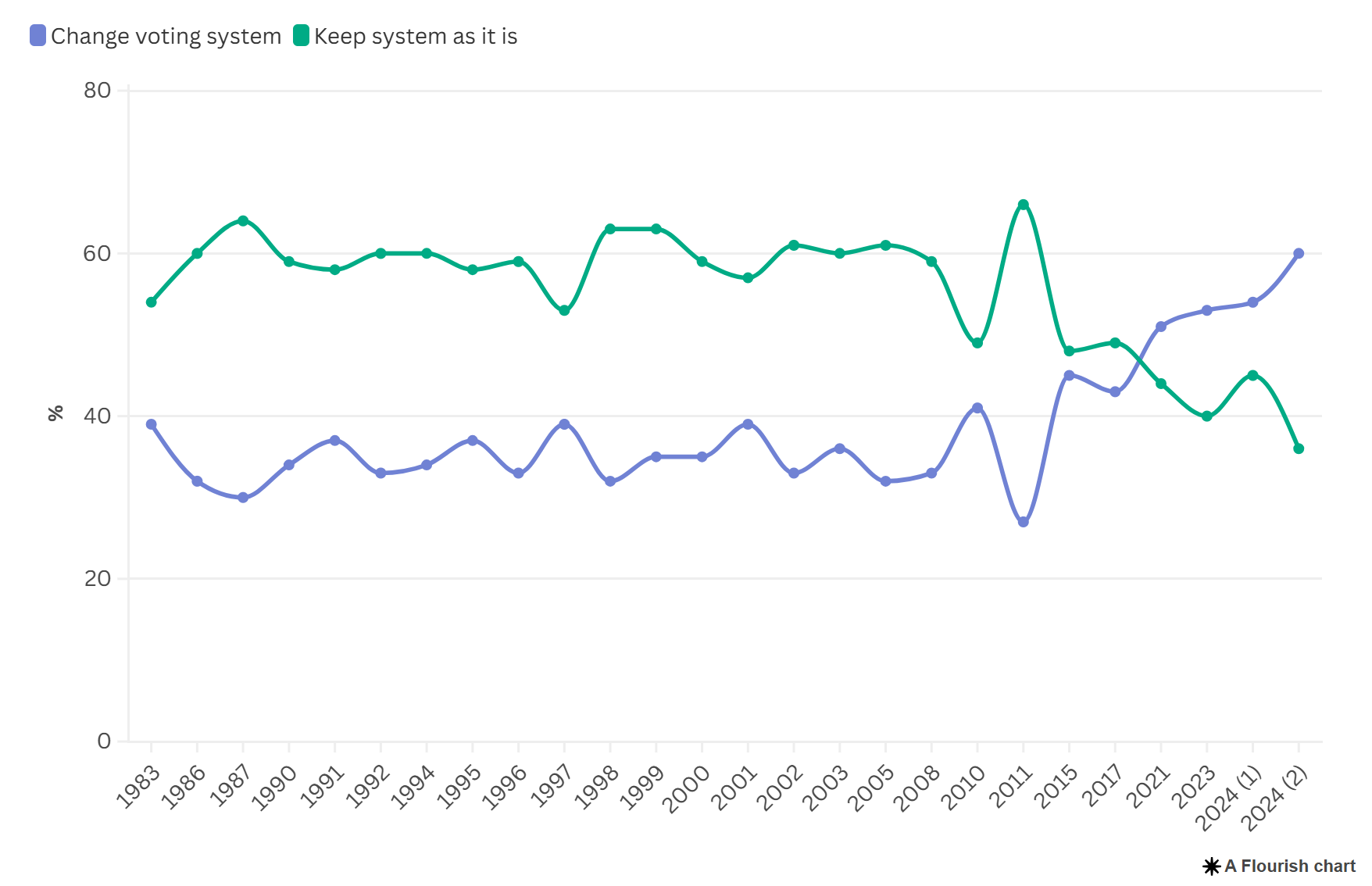
A record-breaking 60% of the British public now say they want our electoral system to be changed ‘to allow smaller parties to get a fairer share of MPs’.
At the same time, trust in government has reached an all-time low.
The Government has shown itself willing to reform some elections, reintroducing preferential voting for Mayors and Police & Crime Commissioners (PCCs) after Labour and Reform candidates won on shockingly small shares of the vote.
But despite the clear signs for the need for such change at the national level too, the Government’s published priorities for the upcoming Electoral Reform including no mention of reform towards fairer and more proportional votes in General Elections.
Those priorities did include a welcome commitment to grant 16 and 17 year-olds the vote, but without Proportional Representation, many of those new voters will have no chance of affecting the results, simply because they live in safe seats.
1. Record-breaking support for electoral reform
The findings of this year’s edition of the gold-standard social research study, the British Social Attitudes Survey, were published in June. Its findings included that 60% of people in the UK now support electoral reform ‘to allow smaller parties to get a fairer share of MPs’. (When asked, that is.1)
That figure included more than half of the supporters of every major party. (Yes, you read that right - including more than half of supporters of the Conservatives! Tim Bale has an interesting piece exploring why.)
The BSA has included this same question for more than forty years, and since 2021 the public has consistently backed electoral reform when asked - as shown in the chart below.
In welcome news for Liberal Democrats, the survey also demonstrated that, for the first time, a majority of the public would prefer a coalition over a single-party government (53% vs 41%) - undermining one of the usual arguments for retaining First Past the Post (FPTP).
More generally, the report identified a record low in trust in government, which was picked up by the Guardian here. This presents an opportunity for campaigners for fair votes to make the case to the public that reform would make government more accountable .
The LDER Take: Support for proportional representation isn’t limited to fringe parties. That a majority of supporters of all major parties would prefer a more proportional system demonstrates that reform isn’t about the interests of one party or another - it’s about doing what’s right for the people of the UK.
But we need to be careful not to get carried away: as we explain in the footnote in the end of this piece, high support when asked by a researcher doesn’t necessarily translate into high importance for voters.The record low in trust in government, however, does present campaigners for fair votes with both a challenge and an opportunity: to make the case that electoral reform is the route to restoring trust.
2. Labour say Pfft to FPTP for Mayoral and PCC elections
The Government reintroduced the Supplementary Vote (SV) for Mayoral and Police and Crime Commissioner elections, as part of its English Devolution and Community Empowerment Bill, after multiple Mayoral elections this year resulted in wins on tiny shares of the vote (as low as 24% in one instance).
Media coverage, however, presented this step largely in terms of the perceived advantage it would lend one party or another.
The LDER Take: : Media coverage once again sees change only through the prism of party advantage. The voting public is ignored. Unless we engage with the press to change the narrative, we should expect to see the same in coverage of reform for fair votes for General Elections.
The reform itself is welcome, however. While our preferred system is the Alternative Vote (AV), which allows voters to rank all candidates rather than just a first and second preference, SV is a great improvement upon FPTP because it guarantees the eventual winner to command at least 50% of the votes, whether from first or second preferences.
3. The Government’s ‘Strategy for Elections’ statement
Announced in July, the strategy set out the Government’s priorities for the forthcoming Elections Bill. The full statement is here, and this is the accompanying press release.
Most media reporting to date has followed the press release line of votes for 16 and 17 year olds, debating the pros and cons of such a change.
Perhaps future media coverage will also address the elephant in the room: that trust in government is at an all-time low, a cross-party majority of the public support electoral reform (when asked), and yet the Government persists in taking no action to deliver fairer votes.
The LDER Take: Votes for 16 and 17 year-olds is welcome. Without Proportional Representation, however, many of those new voters will have no chance of affecting the results, simply because they live in safe seats.
4. Beyond government
Labour needs PR to stop Reform, argues Guardian columnist Will Hayward
Andy Burnham advocates PR to counter ‘dangerous, alienating times’
Readers of the Independent say we need electoral reform over and above Corbyn’s new party.
More Conservatives - Nigel Evans and Robert Colville - back electoral reform even if reluctantly.
YouGov’s Peter Kellner supports voting system (though not proportional representation) change to stop Farage
A new column in The Economist looks at electoral reform - including compulsory voting.
The LDER Take: Compulsory voting isn’t the answer. It shouldn’t even be contemplated until we have a voting system that makes it worth people’s while going out to vote in the first place. Compulsory advocates often cite Australia - but forget to point out that the Aussies already have preferential voting for both its parliamentary chambers!
And Tom Clark sees the light over in Prospect, with his piece ‘PR is no longer unthinkable’
The LDER Take: ‘Another article stressing that PR is now realistically on the agenda - driven by the fragmentation of the UKs political parties. PR/Fair Votes is leaving ‘Nerd-istan’ and moving to the mainstream.’

Thank you
We hope this report is useful to you. If you found this newsletter helpful, you can sign up to receive by providing your email above. If you would like to discuss these updates, or unsubscribe, please mail info@lder.org.
If MPs want to join the APPG on Fair Elections, please mail joe@fairvote.uk or mark@fairvote.uk. The APPG website is at: https://www.fairelections.uk/
To join LDER please go to https://www.lder.org/join-us or to get our regular newsletter updates, go to https://www.lder.org/sign-up-for-updates
It’s important to remember that research questions like this might indicate people’s views on an issue are when prompted by a researcher, but don’t indicate how far those same people are preoccupied by, or care about, the same issue when going about their daily lives unaccosted by researchers with clipboards.
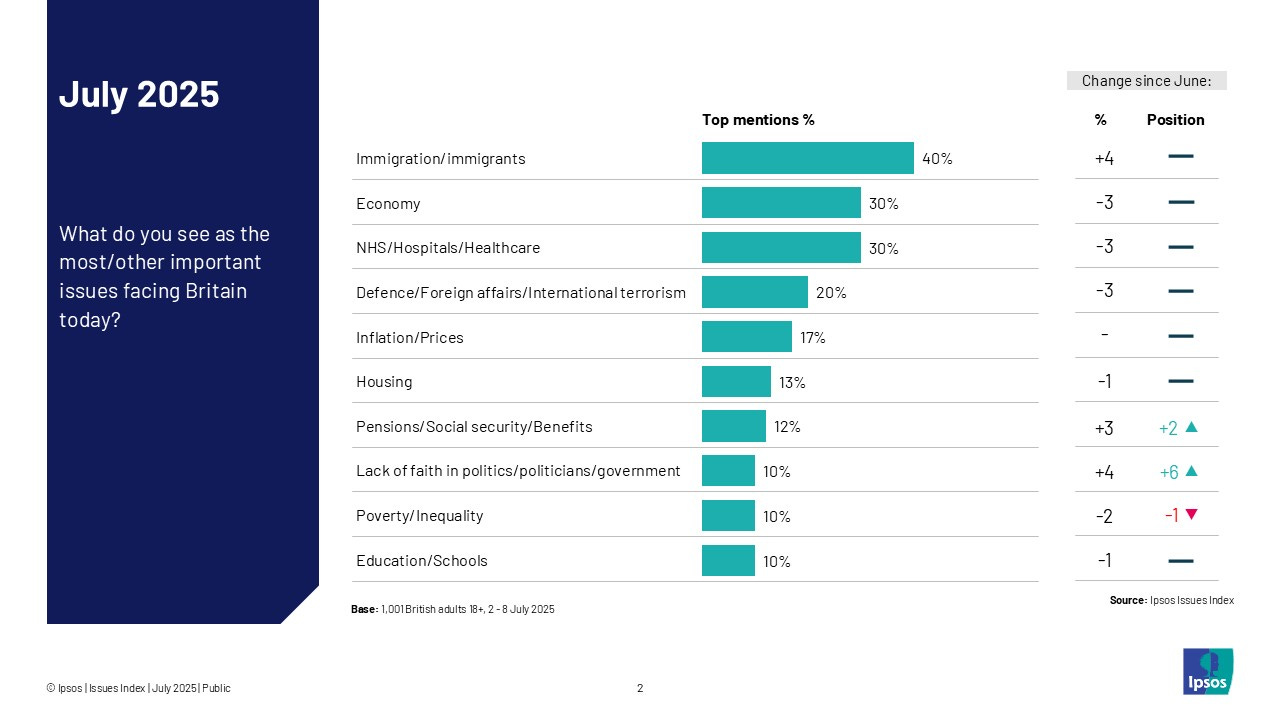
When pollsters take the opposite approach and ask the public what their most important issues are, questions of improving our political system often appear low on the list, relative to other priorities. Here’s a recent example from Ipsos, that shows that ‘Lack of faith in politics/politicians/government’ is only mentioned as a top concern by 10% of the population.